

by Gray Fitzsimons, Research Associate, Saab Center for Portuguese Studies, UMass Lowell
As is well known, the overwhelming number of immigrants who settled in Lowell in the early 20th century worked as wage earners in the city’s factories, primarily in the textile industry. Very few were among the professional ranks. But by 1910, as part of the great wave of newer immigrants, a handful of foreign-born, formally trained medical doctors resided in Lowell. This included three Greeks, one Armenian, and one Portuguese. All played important roles in their communities, each attending to the medical needs of their patients who were almost exclusively those from their native land. They not only shared the same language and often the same religion but also many of the same customs.
While having a common nationality, one significant difference that set these physicians apart was that they hailed from markedly different social-class backgrounds than their compatriots. Whether from Greece, Portugal, or the Middle East, these men of medicine (and they were exclusively men), typically came from elite families. Upon settling in Lowell, and despite having to adjust to life in a new, foreign and urban setting, they immediately occupied a privileged social status. Not all but many became civic leaders in their ethnic communities and prominent politicians, businessmen, as well as clergy frequently turned to them to assist in solving innumerable problems of public health, adequate housing, crime, and even labor strife. One notable and early example of this occurred in early 1906 when city officials enlisted several French Canadian and Greek physicians in a campaign to combat tuberculosis.
Between 1900 and 1910 the largest number of immigrants who settled in Lowell came from Greece, Portugal (primarily the Azores), and Polish-speaking regions of Russia, Germany, and Austria. At various times during this decade, there were several Greek physicians, but only one Portuguese medical doctor. (There is no record of a Polish-speaking doctor in the city for these years.) The lone Portuguese physician, Joseph (José) P. Vieira, arrived in Lowell in 1906 when the population of his countrymen and women neared 1,000, although when including their children the figure was closer to 2,500. This represented a staggering number of potential patients for a single doctor.
No records exist of Dr. Vieira’s medical practice in Lowell, and he is a forgotten figure in the city’s early Portuguese community. Born on the Azorean island of São Miguel in 1868, José Pacheco Vieira likely attended the Lyceum in Ponta Delgada before entering the famed Catholic seminary at Angra do Heroísmo Angra on Terceira Island. Although he was an exceptional student he decided against entering the priesthood and left Angra for the University of Lisbon where he completed his medical degree. Upon graduating he received an appointment as a doctor in Portugal’s navy and served for several years in his country’s African colonies. It is not clear when he left his position in the navy, but he returned to São Miguel and lived in Lagoa, a coastal village with the third largest population on the island. Dr. Vieira likely practiced medicine in Lagoa and while there he purportedly asked for the hand in marriage of a “handsome” and “petite” young woman, fifteen years his junior. It was a deed he soon greatly regretted.
In July 1903 Dr. Vieira boarded a vessel bound for Ellis Island. He then traveled to New Bedford where his older brother, Rev. Antonio P. Vieira, a graduate of the Angra seminary, had recently settled as curate at St. John the Baptist Church. (He would live to the age of 98 and, prior to his death in 1964, as pastor of Our Lady of Mount Carmel in New Bedford, he was reportedly the oldest active priest in the United States.) Renting a house near his brother’s church, Dr. Vieira operated his practice in this wood-frame residence for three years. In 1906 he relocated to Lowell. His reasons for doing so are not known although it is likely that a priest, Fr. Joaquim Rosa, who had served as curate at St. John the Baptist, before accepting the appointment as pastor of the newly established St. Anthony’s parish in Lowell (its initial church on Gorham Street in the old Primitive Methodist Church), informed him of the need for a doctor to tend to the city’s growing Portuguese population.
Unlike many of Lowell’s physicians who lived in more affluent neighborhoods, Dr. Vieira rented a room in a tenement on heavily trafficked Gorham Street, steps away from St. Peter’s Church. His office was in brick building next door. It had commercial space at street level and apartments above. At this time, the surrounding area teemed with a large Irish working-class population. Nearby, in the vicinity of Winter Street, this part of the city had a well-deserved, notorious reputation boasting of run-down, illicit houses of pleasure and unlicensed drinking establishments. It was one of the least popular police beats in Lowell with constant petty crime, drunkenness, brawling, and various forms of cheap, often illegal entertainment.
Notwithstanding its less than prestigious address and lack of amenities, Dr. Vieira’s office was near the heart of the Portuguese “colony.” The extent to which patients called upon him at his Gorham Street practice is not known but he gained the reputation, noted one Portuguese-language newspaper, as “a great friend to the poor, whom he aided by visiting their sick without charging a single cent for his services, often he even paid for necessary medicine out of his own pocket.” Along with Fr. Rosa, Dr. Vieira became a sharp critic of landlords who owned tenements, particularly in Back Central and the wretched housing in which many Portuguese lived. Directing attention to Lowell’s Board of Health, Vieira declared, “I do not understand why the health authorities of the city allow the poorer tenements in the vicinity of Charles and Gorham street to remain in such a dilapidated condition. The walls are often filthy, boards and steps are broken, and balustrades are missing.” He also warned that “tuberculosis is beginning to develop among our people; they are accustomed to fresh air and sunlight, and they sicken in the tenements.”
The most common, often fatal illnesses that Dr. Vieira had to treat were respiratory in nature and afflicted especially very young children and elderly adults. Over a ten-year period (between 1900 and 1910) in one boardinghouse on Charles Street, that had exclusively Portuguese residents, a child below the age of five-years old died every year. The only neighborhood that had a higher death rate than Back Central was Little Canada. As the only Portuguese physician in the city, Dr. Vieira must have found his case load quite challenging. Undoubtedly, he found some solace in his Catholic faith. He became close to Fr. Rosa and remained very attached to his brother, who occasionally came to Lowell and even gave the inaugural sermon at the opening of the new St. Anthony’s Church on Central Street in 1908.
In addition to the burdens of his medical practice, Dr. Vieira also had to contend with a public scandal that was plastered across the front pages of Lowell’s newspapers. This entailed a lawsuit alleging a breach of promise of marriage which the plaintiff, Maria da Luz Mello, brought forward in a jury trial in Lowell’s superior court. Represented by an Irish-American lawyer from Fall River and testifying at length in her native tongue, da Luz Mello described the courtship of the good doctor, some three years earlier, at her home in Lagoa and his proposal of marriage in the presence of her mother. She claimed she was “a poor girl” and not worthy of being wed to someone of his status, but that he promised to marry her despite any social-class distance between them. She received no further communication from him and only learned of his whereabouts from someone returning to the Azores from America. She soon embarked on a steamship bound for New England.
Upon on arriving in Lowell da Luz Mello immediately sought out her would-be husband. No doubt to the doctor’s astonishment, she suddenly appeared in his office one fine September day. According to his testimony he greeted her cordially but upon learning of her intentions he firmly denied her claims that he had sent for her with a promise to marry. When she pleaded she wished to live with him as his housewife, he said it could not be so. He then suggested she find a boardinghouse, called for a coachman, and gave him an address where to take her. Before stepping onto the hansom cab, she asked the doctor for money, to which he replied he had none to give her. She asked again to be his wife and upon being turned down she remarked rhetorically, “Is it not [for you to marry] a free country?” Dr. Vieira rejoindered, “It is free, but not for everything.” After a brief deliberation the jury found for the plaintiff, awarding her $1000 (about $35,000 today). In assessing the trial and the doctor’s conduct, one headline stated: “His Idea of Our Law Hazy.”
The amount of the award received by Maria Luz de Mello is not known, but she returned to São Miguel and lived there for a few years. Eventually she immigrated to the United States, settling in Fall River where she worked in the highly skilled position of yarn drawing-in on warp beams in a cotton mill before marrying a fellow Portuguese immigrant, a shoemaker, from her island, and having four children. She lived many years in Warren, Rhode Island, before her passing in 1960.
Despite the embarrassment and financial setback following the jury’s verdict, Dr. Vieira remained in Lowell, at his Gorham Street address, for another four years. In 1911 he returned to New Bedford and opened a practice near his brother’s church. By all accounts he maintained a sterling reputation. But he never married and, unlike many immigrants who were in the professional ranks, he never owned property nor did he ever become a United States citizen. For a short time, he lived with his brother (who did naturalize) in the rectory of Our Lady of Mount Carmel Church, where Fr. Antonio Vieira was appointed pastor. He moved back to São Miguel and died there in 1942.
For nearly a decade Lowell had no Portuguese physician. By 1921, however, a young Portuguese-American doctor, who was born in Somerville and graduated summa cum laude from Tufts Medical School, established a practice in the Spindle City. While he might have had some Portuguese patients, it appears he served many others without distinction to ethnic background. He married, had children, and lived in the Belvidere section of Lowell. Dr. Cunha also had his office in the downtown, some blocks away from Back Central. In the late 1920s he received a fellowship in Vienna, Austria, to do post-graduate work in surgery. He returned briefly to Lowell before moving with his family to San Francisco and it was there he gained professional renown as a surgeon in the field of gastroenterology.
In the fall of 1931, a new physician, Dr. Fausto Lage, moved to Lowell. Born in Oporto, Portugal, he was one of the few Portuguese in the city from the Continent. He would soon become one of the best-known figures in the Portuguese community. (To be continued)
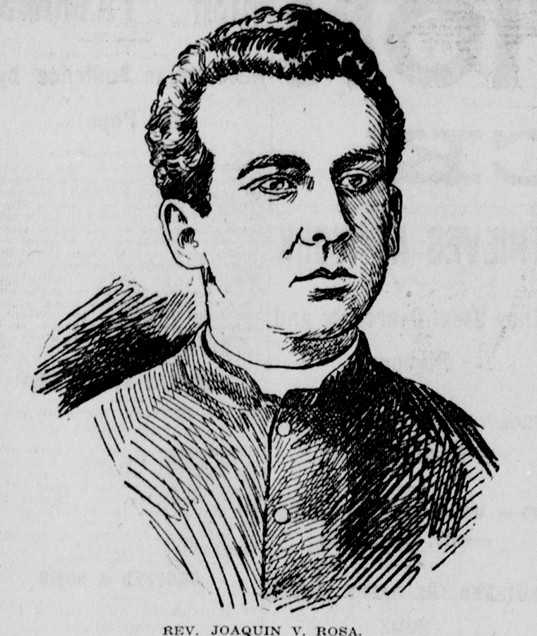
The first pastor of Lowell’s St. Anthony’s Church, Rev. Joaquim V. Rosa likely encouraged Dr. Vieira to move from New Bedford to the Spindle City to serve as a physician to the growing Portuguese community in Back Central. The two worked closely together and demanded the City take greater action to improve housing and living conditions for residents in the neighborhood. (Engraving from Lowell Sun, October 25, 1902)
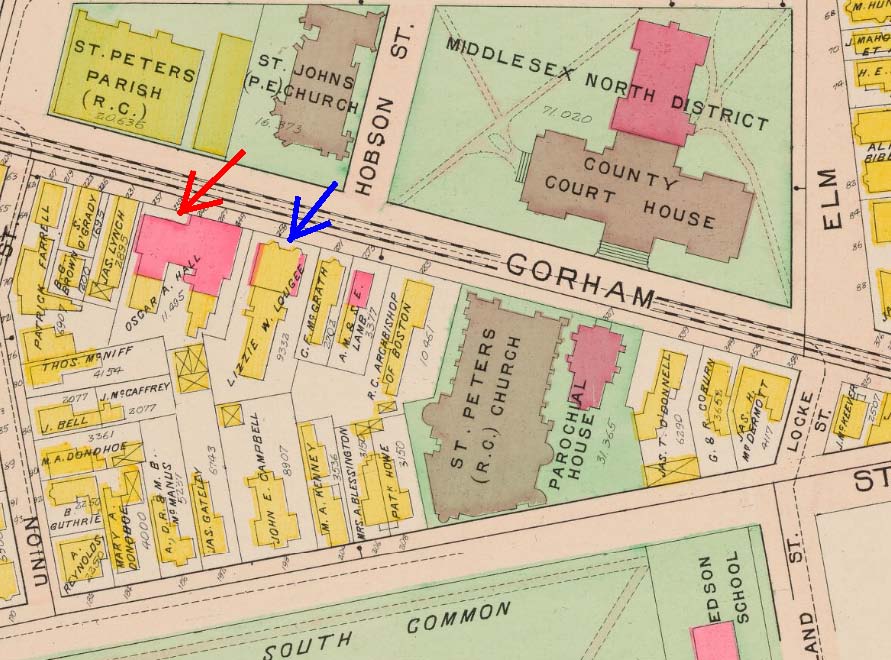
During his years in Lowell, Dr. Vieira lived unostentatiously in a wood-frame apartment building (blue arrow) on Gorham Street in Back Central. His medical office was next door (red arrow). (Source: 1906 Atlas of Lowell, Center for Lowell History)
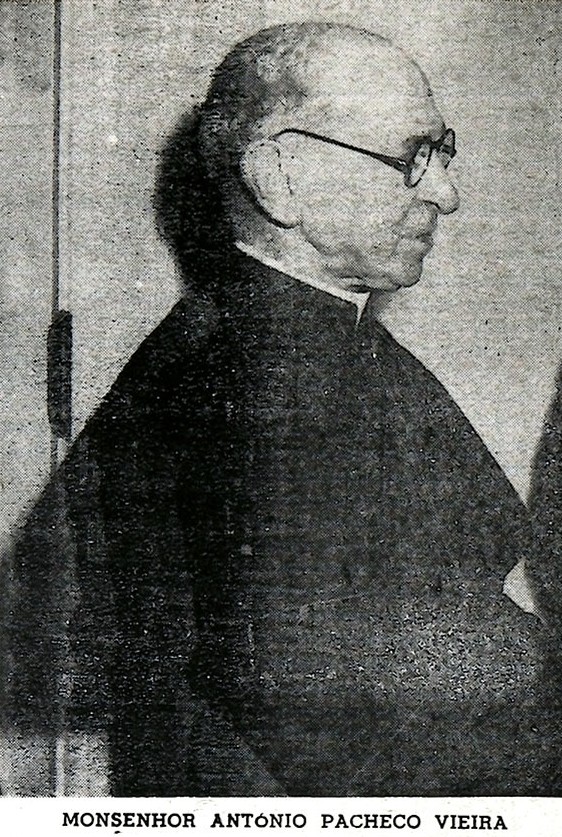
The elder brother of Dr. Vieira, Rev. Antonio P. Vieira was ordained after completing his studies at the famous seminary, Angra do Heroísmo, on the Azorean island of Terceira. He immigrated to the United States in 1906 and settled in New Bedford, where he remained for the rest of his life. For nearly 60 years he served Portuguese parishioners as pastor at New Bedford’s Our Lady of Mount Carmel Church. When he died in 1964, at the age of 98, he was the oldest active priest in the United States. (Photo from Diario de Noticias, March 27, 1964)